01 / 03

Space Systems · IAC-26 · 2026

High-Resolution CubeSat
Earth Observation Payload
Using COTS Components

Overview

Abstract submitted for oral presentation at the International Astronautical Congress 2026 (IAC-26), titled Development of a High-Resolution CubeSat Earth Observation Imaging Payload Using Commercial Off The Shelf Components. Currently under review. The work presents the design methodology, component selection rationale, and integration approach developed through the Galassia-5 CubeSat program at NUS.

Research Question

Can commercially available optical and sensing components be selected, integrated, and qualified to meet high-resolution Earth observation performance targets within the volume and budget constraints typical of student and low-cost CubeSat programs — without relying on traditional space-grade supply chains?

Key Contributions

  • Systematic optical system design methodology for COTS-based CubeSat payloads
  • Sensor-to-optics integration approach within a 2U volume envelope
  • Trade-off framework for cost, performance, and procurement feasibility
  • System-level integration methodology with the satellite bus architecture

Abstract Under Review — IAC-26
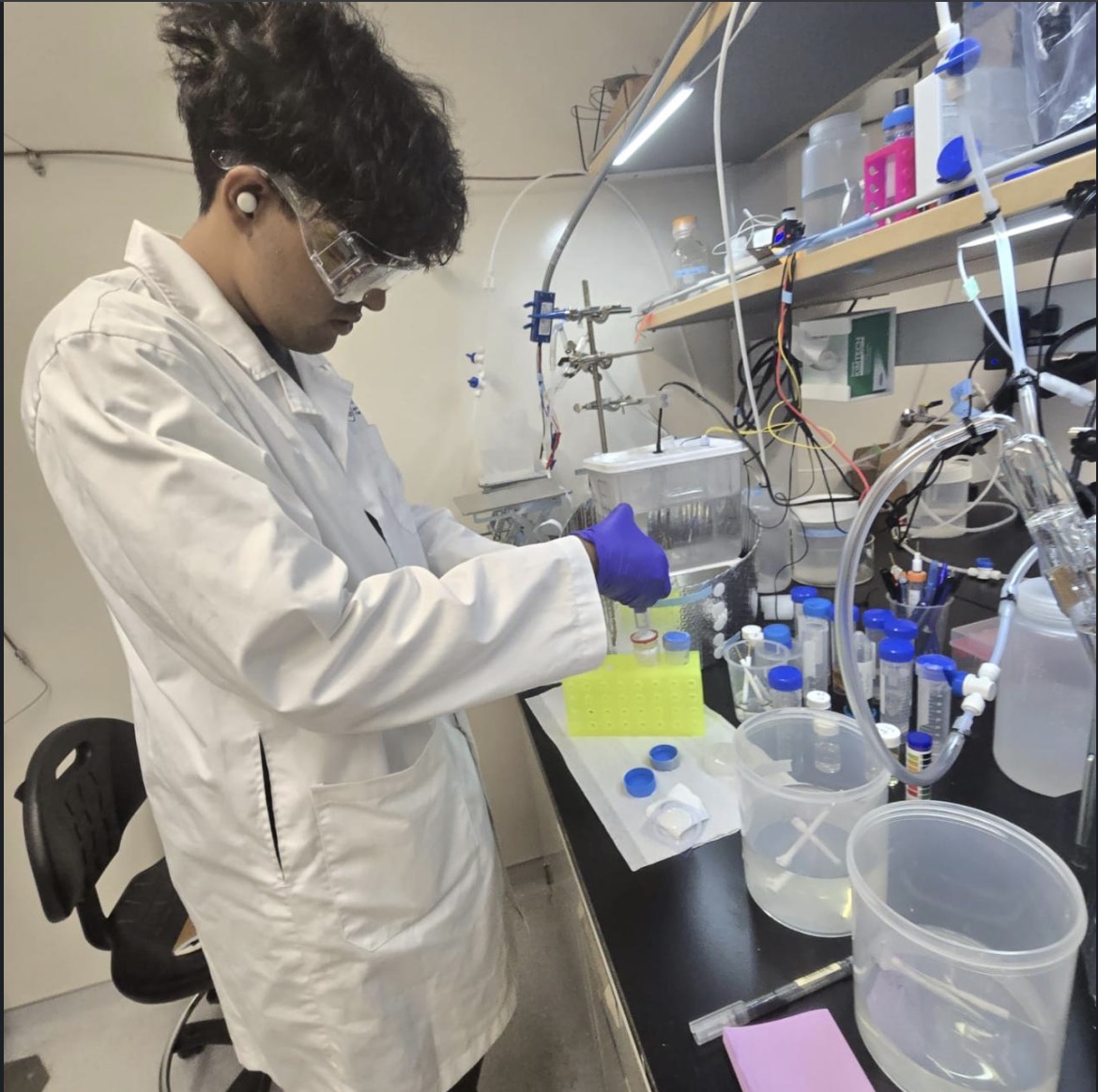
NiFeLa multicomponent catalyst HER research at Boettcher Lab

02 / 03

Electrochemistry · UC Berkeley · Summer 2025

Optimisation of NiFeLa
Catalysts for Alkaline
Hydrogen Evolution

Context

Conducted at the Boettcher Lab, University of California Berkeley, under the mentorship of Prof. Shannon Boettcher and Dr. Emma Kaeli — two of the most recognised electrochemists in North America. Part of a Summer Sessions program covering three courses in electrochemistry and electrochemical engineering.

Research Focus

Optimisation of multicomponent NiFeLa catalysts for alkaline Hydrogen Evolution Reaction (HER) applications. The work characterised how lanthanum incorporation into nickel-iron catalyst systems affects reaction kinetics and overpotential performance in alkaline electrolyte conditions.

Methodology

  • Employed potentiostatic electrochemical measurements to characterise catalyst activity
  • Conducted Tafel analysis to determine exchange current density and Tafel slope across catalyst compositions
  • Applied kinetic modelling to quantify reaction rates and identify rate-determining steps
  • Evaluated catalyst performance as a function of NiFeLa composition and preparation conditions

Outcome

Completed as part of the Berkeley Summer program. Findings contributed to ongoing work in the Boettcher Lab on multicomponent alkaline HER catalyst systems.

03 / 03

Reaction Kinetics · IB Diploma · 2022

Reaction Rate Dependence
on Temperature in
5,12-Bis(Phenylethynyl)naphthacene

Research Question

How does the initial rate of the chemiluminescence reaction of 5,12-bis(phenylethynyl)naphthacene vary with the temperature of the reaction mixture, and what does this reveal about the activation energy and optimal temperature range for efficient chemiluminescent output?

Methodology

  • Measured light emission intensity as a proxy for initial reaction rate across a range of controlled temperatures
  • Used Vernier data loggers and calibrated light probes to capture time-resolved luminescence output with precision
  • Applied the Arrhenius method to determine activation energy from temperature-dependent rate data
  • Derived the optimal temperature for maximum chemiluminescent yield from the kinetic analysis

Outcome

Completed as an IB Chemistry internal assessment. Received the Academic Merit Certificate in Chemistry for sustained high performance across the IB programme.

Next

Get In Touch

Contact →